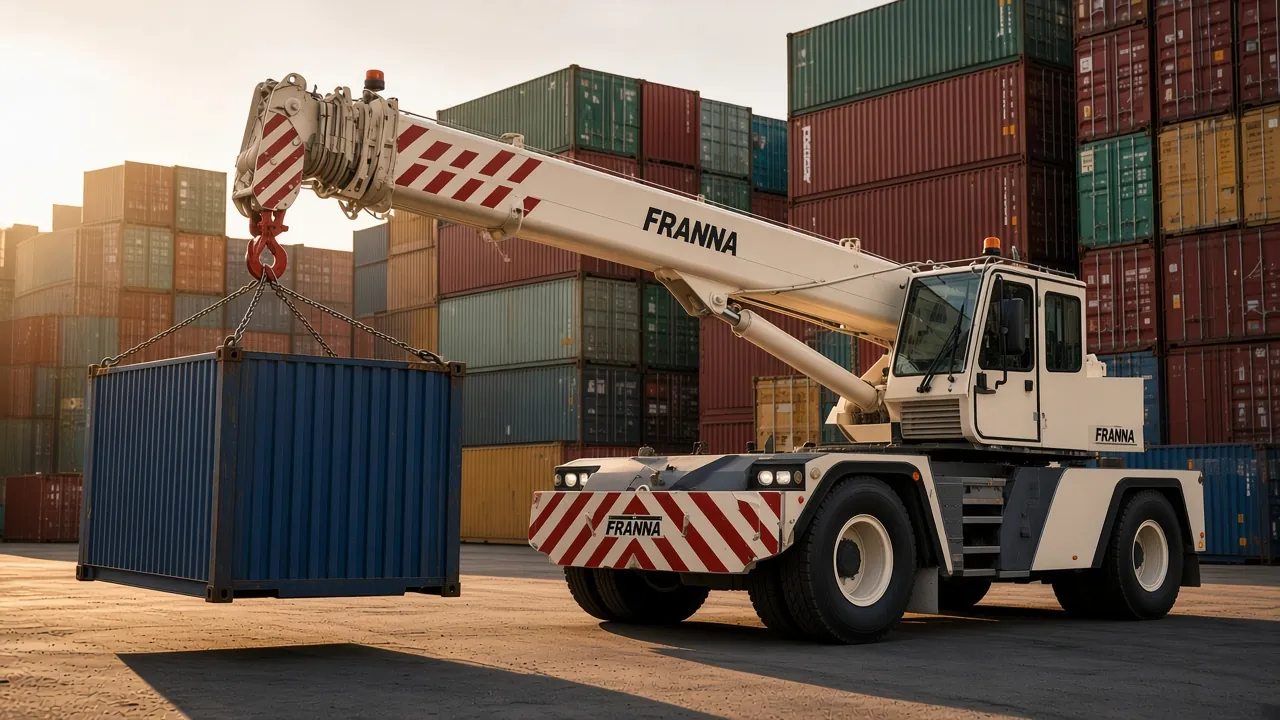
Need a Franna in Brisbane? Tell us what you are lifting, roughly how heavy it is, where it has to go and when. We size the right pick-and-carry crane for the load and the site, send a written quote, and book an operated crane with a licensed and insured operator for your date, including after-hours and weekend lifts.
What a Franna crane actually does
A Franna is an Australian-designed pick-and-carry crane. Unlike a slewing mobile crane, which sets up on outriggers and swings its load around a fixed point, a Franna is built to pick a load up, carry it across the site on its own wheels and set it down where it is needed. The machine bends in the middle, which is why people call it an articulated crane, and that articulation is what lets it steer tightly around yards, warehouses, car parks and building sites.
That one difference changes how a lot of jobs are planned. On a site where a slewing crane would need a large, level pad and a full outrigger set-up, a pick-and-carry crane can often drive in, lift, walk the load to its final position and leave again in a fraction of the set-up time. For short lifts, repeated lifts and loads that need to move a few metres or a few hundred metres across a site, that speed is the whole point.
A Franna is not the answer to every lift. Very heavy loads, long reaches over buildings and lifts that need a high hook height are usually better suited to a slewing all-terrain crane. Part of our job is telling you honestly which type of crane suits your lift, so you are not paying for the wrong machine or finding out on the day that the crane cannot reach.
- Pick up, carry and place a load without setting up outriggers for every move
- Steer tightly through gates, yards, sheds and car parks thanks to the centre articulation
- Lift on and off trucks quickly for delivery, loading and unloading work
- Work inside large sheds and factories where the roof height allows
- Suit short, repeated and multi-location lifts across one site
Jobs we lift every week
Most Franna work in South East Queensland falls into a handful of job types. The detail changes from site to site, but the planning questions are similar: how heavy is the load, where are the lifting points, how far does it travel, and what is the ground like between the truck and the final position.
- Shipping containers: placing, moving and loading 10, 20 and 40 foot containers on properties, sites and yards. See shipping container lifting.
- Structural steel: columns, beams, portal frames and rafters for sheds, warehouses and commercial builds. See steel beam lifting.
- Precast concrete: panels, culverts, pits, headwalls and pipes on civil and building sites. See precast panel lifting.
- HVAC and rooftop plant: condensers, packaged units and chillers lifted to roofs and plant decks. See HVAC and rooftop plant lifts.
- Machinery: factory machines, generators, compressors and plant loaded, unloaded and moved into position. See machinery moving.
- Site buildings: site sheds, demountables, toilet blocks and modular rooms placed and relocated. See site sheds and demountables.
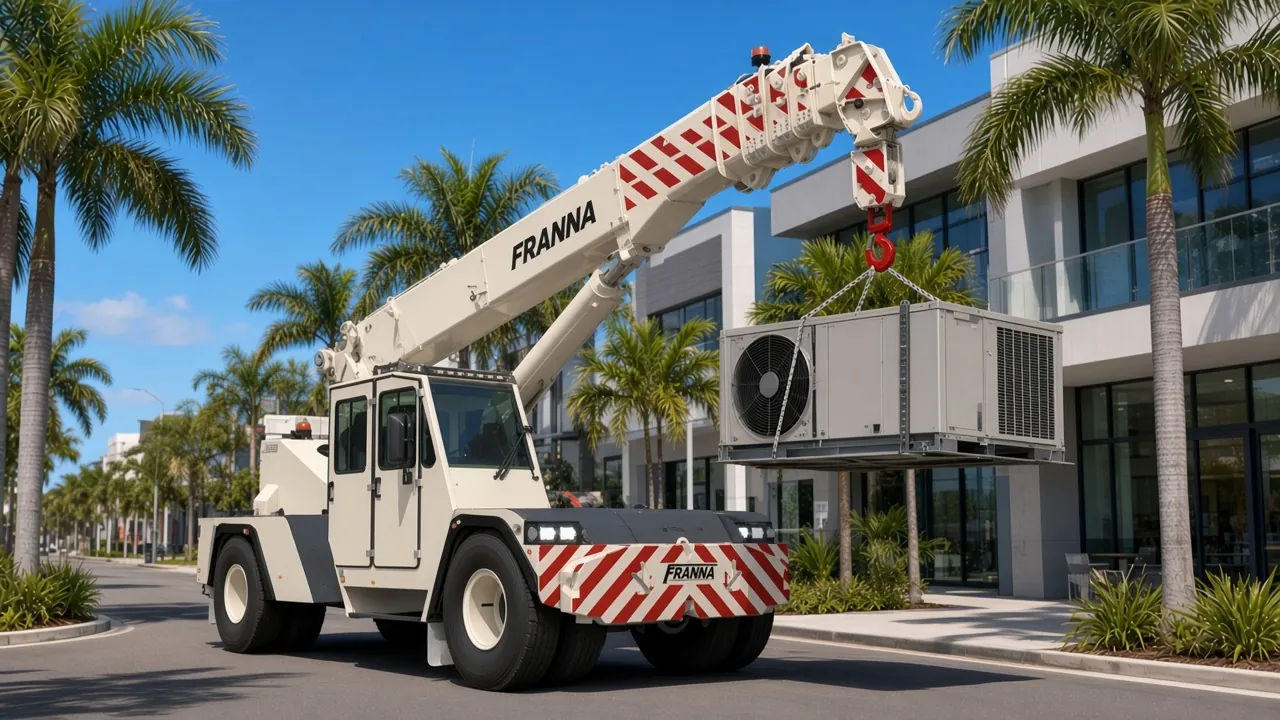
If your job is not on that list, it is still worth asking. Pick-and-carry cranes are used for boats, tanks, pool shells, spa baths, signage, solar equipment, bridge beams, landscaping rocks and plenty of one-off loads that do not fit neatly in a category. The planning approach is the same: we need the weight, the size, the lifting points and the site.
Choosing the right size of Franna
Pick-and-carry cranes come in different capacity classes, and the number on the side of the crane is not the weight it can lift at every reach. The rated capacity is the maximum under ideal conditions, close in, with the crane straight and on firm, level ground. As the boom extends further out, as the load is lifted higher, and as the crane articulates, the safe working load drops, sometimes sharply.
That is why we ask so many questions before quoting. A load that weighs a few tonnes can still need a larger crane if it has to be reached over a fence or a garden bed, or if the crane can only park some distance away. A heavier load can be easy if the crane can drive right up to it on a hard surface. We work from the manufacturer load chart for the crane class, not from a guess.
- 12 to 15 tonne class: smaller, lighter machines for tight sites and lighter loads. See 12 to 15 tonne Franna guide.
- 20 tonne class: the most common all-rounder for general construction and delivery work. See 20 tonne Franna guide.
- 25 tonne class: more capacity at reach for heavier steel, precast and plant. See 25 tonne Franna guide.
- 40 tonne class: the largest pick-and-carry class for heavy loads that still need to be carried. See 40 tonne Franna guide.
Not sure which one you need? The Franna size guide explains how capacity, reach and site conditions fit together, and you can always send us the details and let us do the sizing for you.
Brisbane, the Gold Coast and the Sunshine Coast
We take bookings for lifts across Greater Brisbane, the Gold Coast and the Sunshine Coast. That covers inner-city building sites, the big industrial estates of the TradeCoast, Acacia Ridge, Wacol and Brendale, the growth corridors through Logan, Ipswich and Moreton Bay, coastal construction from Coolangatta to Coomera, and the Sunshine Coast from Caloundra and Kawana up to Maroochydore, Noosa and the hinterland.
Each region brings its own conditions. Brisbane jobs often involve narrow streets, steep blocks, Queenslander homes on stilts and council rules for standing a crane on the road. Gold Coast work is a mix of high-rise sites, canal homes, pool installs and busy commercial strips. Sunshine Coast lifts range from new estates and commercial builds to marinas, rural blocks and hinterland properties with long, steep driveways.
Day, after-hours and weekend lifts
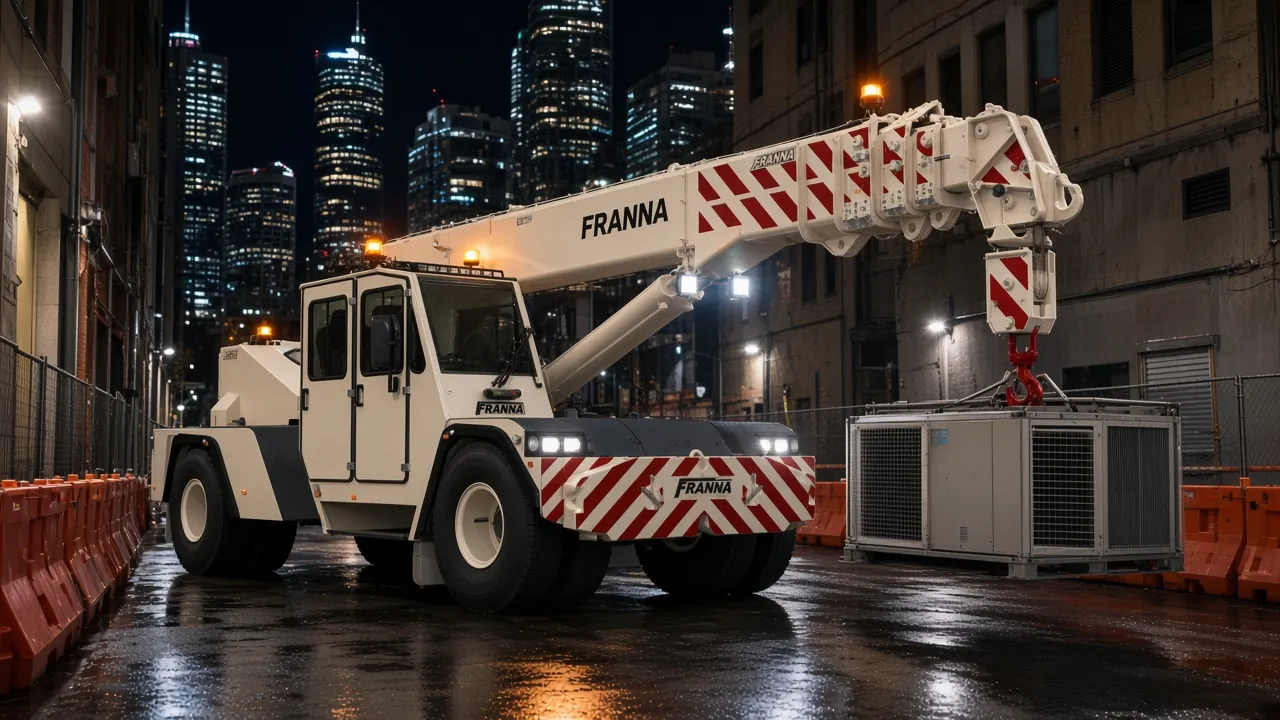
Some lifts cannot happen in normal working hours. Road closures in the city are often only approved at night. Shopping centres, schools, hospitals and factories often want plant lifted when the site is quiet. Shutdown work has to fit around production schedules, and some builders simply need a crane on a Saturday to stay on programme.
We take bookings for after-hours and weekend lifts. Planning matters more for these jobs, because traffic control, permits, lighting and access all need to be lined up in advance. The more notice you can give, the easier it is to line up the right crane, operator and support crew for the time you need. Read more on after-hours and weekend crane hire.
Licensed and insured operators
Every crane we book is operated hire. That means the crane arrives with an operator who holds the right Queensland high risk work licence for the crane class, and the work is covered by insurance. The operator is responsible for setting up and operating the crane safely, working to the load chart, and stopping the lift if conditions change, such as wind picking up or ground softening.
Depending on the load, a lift may also need a dogman or rigger to sling the load, guide it and direct the operator. We will tell you when your job needs extra crew, and why, before you book. You are never left guessing about who is doing what on the day.
- Operators hold the Queensland high risk work licence for the crane they run
- Lifts are planned to the manufacturer load chart for the crane class
- Dogman and rigging crew are added where the load or site needs them
- Insurance is in place for the hire, and paperwork can be supplied for site inductions
How booking a Franna works
- Tell us about the lift. Use the quote form to send the load, approximate weight and size, the site address, the access and your preferred date. Photos are a big help.
- We size the crane. We check the weight against the reach, the ground and the access, and choose the crane class and any rigging crew the job needs.
- You get a written quote. The quote lists the crane, the crew and what is included. Nothing is booked until you approve it.
- We confirm the details. Closer to the day we confirm timing, access, any permits or traffic control, and site induction requirements.
- The lift happens. The operator arrives, checks the site, runs the pre-lift checks and completes the lift to the plan.
What to send for a fast, accurate quote
The quickest quotes come from the best information. You do not need engineering drawings for most jobs, but the more of the following you can include, the fewer phone calls and surprises there are.
- What the load is, and roughly what it weighs. A manufacturer plate, delivery docket or supplier spec sheet is ideal.
- The size of the load and where the lifting points are, if it has them.
- Where the load is now, and where it needs to end up.
- How close the crane can park to the pick-up and set-down points.
- Photos of the access: the gate, driveway, ground surface, overhead wires and any slopes.
- Your preferred date and time, and whether it needs to be after hours or on a weekend.
Site conditions that change a lift
Two lifts with the same load can need completely different cranes because of the site. Pick-and-carry cranes carry their loads, so the ground between pick-up and set-down matters as much as the reach. A Franna travelling with a load needs a firm, reasonably level path. Soft lawn, fresh fill, steep driveways and slopes all reduce what can be done safely.
Overhead powerlines are the other big one. Queensland sets exclusion zones for cranes working near overhead lines, and most residential and commercial streets in South East Queensland have them. If the lift has to happen near powerlines, we plan around the exclusion zone or arrange the extra controls the job needs. Trees, awnings, carport roofs and building edges can also restrict the boom.
- Ground: concrete, asphalt and compacted road base are best; soft ground may need mats or a different approach
- Slope: cross-falls and steep driveways reduce capacity and can rule out carrying a load
- Overhead: powerlines, trees and roof lines all affect where the boom can go
- Access: gate widths, turning space and height clearances decide which crane can get in
Why people book through us
- Straight answers on crane size. We match the crane class to the load and the site rather than defaulting to the biggest machine.
- Quote first. You get the scope in writing before anything is booked.
- Licensed and insured operators. Operated hire only, with the right licences for the crane.
- Flexible timing. Day, after-hours and weekend lifts across the three regions.
- One request, sorted. Send the job once and we take it from there.
Guides and planning help
If you are planning a lift and want to understand the options first, our guides cover the questions we hear most: what affects the cost of Franna hire, Franna or crane truck, and how to choose the right size. The FAQ answers the common questions about booking, licences, insurance and site preparation.
Reading a load chart, simply explained
Every crane has a load chart, and it is the document that decides whether a lift is safe. It is laid out as a grid. Along one side is the radius, the horizontal distance from the crane to the hook. Along the other is the boom length. Where they meet is the safe working load in that configuration. Pick-and-carry cranes have separate charts, or separate columns, for the crane working straight ahead, articulated to the side, and travelling with the load.
Three things to take from a chart:
- Capacity falls as radius grows. Halve the distance from the crane to the load and the safe working load rises sharply.
- Articulation costs capacity. A crane turned to reach around an obstacle can lift less than the same crane pointing straight ahead.
- Pick and carry is rated lower than a static lift. Driving with a load is what the machine is built for, but it is done within its own, more conservative figures.
When we size a crane for your job, we read across the chart at your real radius and configuration, then add the weight of the hook block and rigging, and check there is a sensible margin. That is why we ask how far the crane can park from the load, not just how heavy it is.
What happens on the day
- Arrival. The operator checks in with your site contact, completes any site induction and walks the lift area.
- Pre-start. The crane's daily checks are done and the ground, overhead hazards and travel path are inspected.
- Briefing. The operator, dogman and your team agree the sequence, the exclusion area and the signals.
- Rigging. Slings, chains, shackles or a spreader are attached to the load's lifting points.
- Test lift. The load is raised just clear of its supports and held, so the rigging, balance and crane can be checked before the real lift.
- The lift. The load is lifted, carried low if it needs to travel, and set down under the dogman's direction.
- Hand-over. Once the load is secure and the slings are off, the crane packs up and leaves the site as it found it.
Weather and timing in South East Queensland
Summer storms build quickly, often in the afternoon, and they bring strong gusts that can stop lifts of panels, sheeting, signs and anything with a large flat face. Booking those lifts for the morning in storm season reduces the chance of a postponement. Heavy rain softens clay and fresh fill, so a site that was fine last week may need mats or a different crane position after a storm. Tell us if it has rained heavily before your booking.
Working with your other contractors
Most lifts involve someone else as well: the steel fabricator delivering, the pool company installing, the electrician terminating, the builder fixing. The crane is often the most expensive item on site by the hour, so lining up the trades and deliveries around it pays. Share your crane booking time with everyone involved, make sure the load arrives before or with the crane, and have the people who will receive the load ready at the set-down point.
Common reasons a lift gets postponed, and how to avoid them
- The load is heavier than stated. A container that still has stock in it, a generator with a part-full tank or a machine with its tooling still fitted can tip a lift over the margin. Confirm the weight in the state the item will be lifted.
- The access is not what the photos showed. A car parked across the driveway, a trailer in the side passage or a new fence panel can block the route. Walk the path the morning of the lift.
- The ground has changed. A storm overnight can turn a firm lawn into a soft one. Tell us as soon as you know.
- The receiving crew is not ready. The crane can hold a load for a while, but an empty excavation, an unprepared footing or a roof crew still on its way costs hire time.
- The paperwork is missing. A road permit that has not come through, or an induction that has not been booked, stops the lift before it starts.
Franna hire questions
How much does Franna crane hire cost in Brisbane?
We do not publish set prices, because the cost depends on the crane class, the hours on site, travel, any rigging crew, permits and access. Send the job details and we will give you a written quote before anything is booked.
Do your cranes come with an operator?
Yes. All of our crane hire is operated hire, with a licensed and insured operator who holds the Queensland high risk work licence for the crane.
Can you do lifts after hours or on weekends?
Yes. We take bookings for after-hours and weekend lifts across Brisbane, the Gold Coast and the Sunshine Coast. Give as much notice as you can so permits, traffic control and crew can be lined up.
What areas do you cover?
Greater Brisbane including Ipswich, Logan, Redlands and Moreton Bay, the Gold Coast, and the Sunshine Coast.
How do I know what size Franna I need?
Send us the load weight, size and the distance between where the crane can park and where the load needs to go. We check it against the load chart for each crane class and recommend the one that suits.
Can a Franna carry a load across the site?
Yes, that is what pick-and-carry cranes are designed for, within the limits of the load chart and the ground conditions along the travel path.
What is a test lift?
Lifting the load just clear of its supports and holding it briefly, so the rigging, balance and crane can be checked before the full lift.
Why do you ask how far away the crane can park?
Because capacity falls with radius. The distance often decides the crane class more than the weight does.
Tell us what you need lifted
Send the load, its rough weight and size, the site address and the date. Photos of the load and the access help us size the right crane first time.
- Licensed and insured operators
- Day, after-hours and weekend lifts
- Brisbane, Gold Coast and Sunshine Coast
- Written quote before the job is booked
Prefer email? info@frannacranehirebrisbane.com.au
Request Received
Thanks ! Someone from Franna Crane Hire Brisbane will call you back shortly. For emergencies right now, please call us directly.
Call 07 3103 9872